 Mahjong PlanetAll stories
Learn Mahjong online: six free beginner courses
· Mahjong Planet
New to Mahjong? Start with 11 free lessons in Riichi, Hong Kong, Sichuan, Taiwanese, Chinese Classical or three-player Riichi. No account needed for lessons.
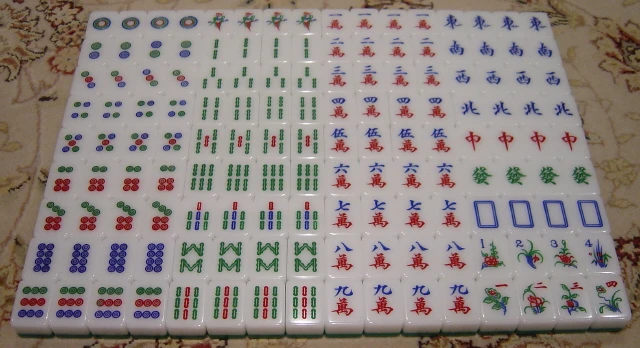
Photo: Immanuel Giel / Wikimedia Commons · Public domain

Start with the tiles
The courses introduce the tiles with examples, then give you decisions to try before your first full game.
Mahjong Planet now has a beginner course for each of its six variants. Each course has 11 lessons, including a guided hand. Start with the tiles, practise small decisions, then bring the pieces together. The lessons and guided hands are free and available without an account.
These courses teach multiplayer Mahjong, the game of drawing and discarding tiles to build a winning hand. If you know Mahjong as a puzzle where you remove matching pairs from a layout, that is Mahjong solitaire. You can still start here with no experience of the multiplayer game.
Which Mahjong variant should you learn first?
If friends or family already play, start with their variant. You will have people to practise with, and you can ask which local rules they use. Our lessons teach the specific presets used on Mahjong Planet; rules at another table may differ.
If you have no preference, the Riichi course is one place to begin. If you are curious about another variant, its course starts from the basics too. You do not need to finish Riichi before trying Taiwanese or Sichuan. Choose one course first so that its rules have time to become familiar.
Riichi: yaku, riichi and furiten
Our four-player Riichi course introduces the suits and honors, groups and pairs, drawing and discarding, and the scoring patterns called yaku. It also explains riichi declarations and furiten, a restriction on winning from a discard.
One early lesson is that a complete shape alone is not enough: you need a yaku. The course lets you work through that idea with examples before the guided hand.
Hong Kong: groups, calls and fan
The Hong Kong Old Style course starts with four sets and a pair. It then introduces claiming discards, flowers and seasons, and fan, the scoring units used to value a winning hand.
You learn the winning requirements for our preset along the way. This is a useful choice if Hong Kong Mahjong is the game you want to play with friends.
Sichuan: exchange tiles and choose a missing suit
Our Sichuan Blood Battle course uses only the three numbered suits. It walks through exchanging three tiles, declaring a missing suit and clearing that suit before winning.
After a player wins, the remaining players continue. The lessons explain this change of rhythm, as well as the end-of-hand payments, before you try the guided hand.
Taiwanese: five sets and a pair
Taiwanese Mahjong starts with 16 tiles in a normal hand, rather than 13. Its standard winning shape has five sets and a pair: 17 tiles, before the extra tiles in declared kongs.
The course builds that shape step by step, then covers calls, flowers and seasons, and the tai scoring used in our preset. You can begin here even if you have never played a 13-tile variant.
Chinese Classical: points and doubles
Chinese Classical returns to four sets and a pair, with scoring built from basic points and doubles. The course explains how those parts fit together and why payments can also pass between players who did not win.
You will learn the difference between a hand and a longer match, then practise reading a result in the guided hand.
Three-player Riichi: three seats and a smaller tile set.
Three-player Riichi, also called sanma, keeps the need for a yaku but changes the table. Our preset removes characters 2 through 8 and lets you set aside North tiles for a bonus, taking replacement tiles.
The course teaches these rules from the beginning, including why a bonus does not replace a yaku. You do not need to know four-player Riichi first.
Practise each decision before reading the answer
Start with the tiles and the winning shape. When a lesson asks you to choose a tile or answer a question, make your choice before reading the explanation. A mistake is a useful chance to see which rule you missed.
Use the guided hand to connect the individual ideas. It is a teaching exercise, so you can concentrate on the decision in front of you. Revisit any lesson when you need it; the courses do not lock later lessons behind earlier ones.
When you want to move on to a full game, create a free account and choose computer opponents or a table with other players. You can keep the rules page nearby and let the site calculate the score. For your first games, recognising the tiles and making a legal winning hand is plenty to work on.