Riichi Mahjong rules
Four-player Japanese Mahjong, with yaku, riichi and no red fives.
Mahjong Planet preset: planet-riichi-no-red-v1
Rated and casual tables, Quick Play, private games and computer practice. Standard and Relaxed ratings are separate.
Tiles, setup and the aim
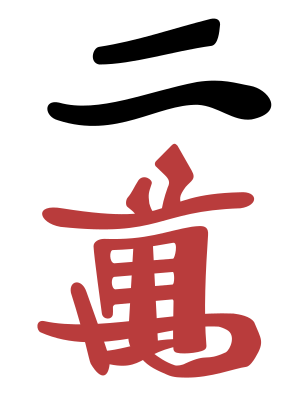
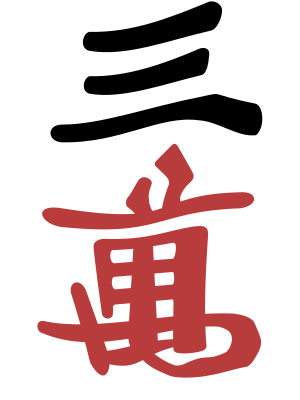
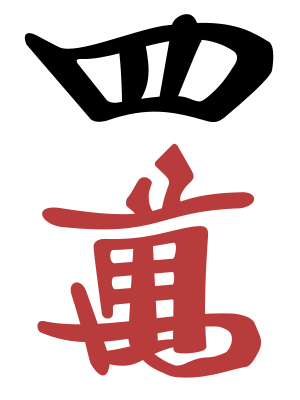
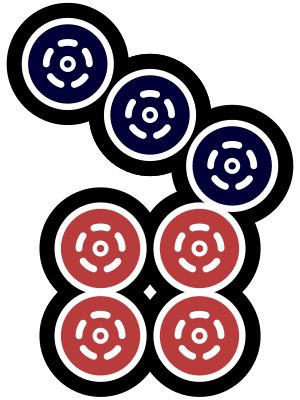
Four players use 136 tiles: four copies of the 34 types. There are three suits (characters, circles, bamboo), four winds and three dragons. No flowers, seasons or red fives. White dragon may look like a blank tile; it is a dragon, not a joker.
Players begin with 25,000 points and 13 tiles. East draws the fourteenth tile first. A standard winning hand contains four groups and a pair. Closed seven distinct pairs and thirteen orphans are special shapes. At least one yaku is required to win; dora alone does not qualify.
A normal turn draws one tile, then discards one. Tsumo wins on your own draw; ron wins on another player’s discard. A 14-tile dead wall provides replacement draws and dora indicators.
Recognising groups
A sequence uses three consecutive ranks in the same suit. A triplet uses three identical tiles, a kong four, and a pair two. Sequences cannot wrap from 9 to 1. Honors cannot form sequences. A kong counts as one group and gets a replacement tile.
Calls, riichi and dora
Chi (chow) claims a sequence only from the preceding player. Pon (pung) claims a triplet from any player. Kan claims or declares four identical tiles and draws a replacement. Ron has priority over calls; pon/kan outrank chi. Up to two players can win on one discard; three ron claims cause an abortive draw.
Calling chi, pon or an exposed kan opens your hand. A concealed kan keeps it closed. After calling, you cannot immediately discard the called tile type or the prohibited alternate end of that sequence (kuikae). Added kans can be robbed. Concealed kans cannot be robbed in this Riichi preset, including by thirteen orphans.
Riichi requires a closed ready hand, at least 1,000 points and at least one remaining opportunity to draw (four or more live-wall tiles). Pay 1,000 points and discard sideways. Afterwards, drawn tiles are automatically discarded unless you win or make a permitted concealed kan that preserves your waits. A successful riichi winner may count ura-dora.
Dora is the tile after its indicator: suited 9 cycles to 1; winds cycle East–South–West–North; dragons cycle White–Green–Red. Each dora in the winning hand adds one han. Kan-dora, kan-ura and ippatsu are enabled. Exposed-kan indicators are revealed after the replacement discard unless another kan intervenes; concealed-kan indicators are revealed immediately. No red-dora bonus applies.
Furiten: when ron is unavailable
If any tile that completes your current hand appears in your own discard history, you cannot ron on any of your waits. This includes tiles another player called from your discards. You may still win by self-draw.
Letting a discard that completes your hand pass makes you temporarily furiten until your next draw, even if the completed shape had no yaku. If you have declared riichi, passing a legal win by discard blocks ron for the rest of that hand. The table checks furiten before offering a win.
Yaku reference
Closed means no open calls; a concealed kan is allowed. Compatible yaku add together. Stronger replacement patterns do not also count their weaker forms.
| Yaku | Han / hand | Requirement |
|---|---|---|
| Riichi | 1 / closed | Declare a closed ready hand with a 1,000-point deposit. |
| Double riichi | 2 / closed | Riichi on your first discard, before any call; replaces riichi. |
| Ippatsu | 1 / closed | Win within the first uninterrupted turn cycle after declaring riichi. Calls cancel it. |
| Closed self-draw | 1 / closed | Win by drawing with a closed hand. |
| All simples (tanyao) | 1 / either | Only suited ranks 2–8. Open all simples is allowed. |
| Pinfu | 1 / closed | Four sequences, a non-value pair and a two-sided sequence wait. |
| Identical sequences (iipeikou) | 1 / closed | Two identical sequences in one suit. |
| Value honors (yakuhai) | 1 each / either | A dragon, seat-wind or prevailing-wind triplet/kong. Double wind earns both. |
| Last draw / last discard | 1 / either | Win on the last live-wall draw or its discard. |
| After a kan (rinshan) | 1 / either | Self-draw on a kan replacement tile. |
| Robbing a kan (chankan) | 1 / either | Win on a tile added to an exposed triplet. |
| Seven pairs | 2 / closed | Seven distinct pairs; a quad does not count as two pairs. |
| All triplets (toitoi) | 2 / either | Four triplets/kongs and a pair. |
| Three concealed triplets | 2 / either | Three concealed triplets/kongs. A triplet completed by ron is open for this count. |
| Three kans | 2 / either | Three declared kongs. |
| Mixed triple triplets | 2 / either | The same rank in triplets/kongs of all three suits. |
| All terminals and honors | 2 / either | Only suited ones/nines and honors; combines with all triplets or seven pairs. |
| Little three dragons | 2 / either | Two dragon groups and a dragon pair; also earns the two value-honor bonuses. |
| Mixed triple sequence | 2 closed / 1 open | The same sequence in all three suits. |
| Pure straight | 2 closed / 1 open | 123, 456 and 789 in one suit. |
| Mixed outside hand | 2 closed / 1 open | Every group and pair contains a terminal or honor; includes a sequence and honors. |
| Two pairs of identical sequences | 3 / closed | Four sequences arranged as two identical pairs; replaces iipeikou and seven pairs. |
| Half flush | 3 closed / 2 open | One suit together with honors. |
| Pure outside hand | 3 closed / 2 open | Every group and pair contains a terminal, with at least one sequence and no honors. |
| Full flush | 6 closed / 5 open | All tiles in one suit, without honors. |
Yakuman and limit hands
Yakuman are thirteen orphans, four concealed triplets, big three dragons, little four winds, big four winds, all honors, all terminals, all green, nine gates, four kans, heavenly hand and earthly hand. Heavenly hand is the dealer’s initial winning hand; earthly hand is a non-dealer’s first uninterrupted self-draw.
Double yakuman apply to thirteen orphans on a thirteen-sided wait, four concealed triplets on a pair wait, pure nine gates (nine-sided wait), and big four winds. Compatible yakuman stack. Counted yakuman starts at 13 han; ordinary han bonuses are not added to a yakuman hand.
Responsibility payment (pao) applies when a call completes the exposed dragon or wind groups for big three dragons or big four winds. On self-draw the responsible player pays the covered yakuman amount; on a discard win that amount is split with the discarder, unless they are the same player. Other yakuman portions are paid normally.
| Yakuman | Requirement |
|---|---|
| Thirteen orphans | Closed: one of every suited 1 and 9 and all seven honors, plus a duplicate of one of those thirteen types. |
| Four concealed triplets | Four concealed triplets/kongs and a pair. Ron must complete the pair; a ron-completed triplet is not concealed. |
| Big three dragons | Triplets/kongs of all three dragons. |
| Little four winds | Three wind triplets/kongs and the fourth wind as the pair. |
| Big four winds | Triplets/kongs of all four winds; double yakuman. |
| All honors | Only winds and dragons. |
| All terminals | Only suited ones and nines, without honors. |
| All green | Only 2, 3, 4, 6, 8 bamboo and green dragons. |
| Nine gates | Closed: 1112345678999 in one suit, plus one extra tile of that suit. |
| Four kans | Four declared kongs and a pair. |
| Heavenly hand | Dealer wins on the initial draw, before any kan. |
| Earthly hand | Non-dealer wins on their first draw before any call or kan. |
Han, fu and payments
Han comes from yaku plus eligible dora. Fu begins at 20: add 10 for closed ron, 2 for self-draw (except pinfu self-draw), 2 for a value pair (4 for a double-wind pair), and 2 for a pair, closed or edge wait.
Triplet fu: open simple 2, concealed simple 4, open terminal/honor 4, concealed terminal/honor 8. Kong fu is four times the corresponding triplet value. A triplet completed by ron is treated as open for fu.
Round fu up to the next ten. Seven pairs stays at 25 fu. Pinfu self-draw stays at 20 fu; closed pinfu ron is 30. An otherwise 20-fu open ron is treated as 30 fu.
Below the limits, base points are fu × 2^(han + 2), capped at 2,000. Ron pays base × 4 to a non-dealer or base × 6 to the dealer. For non-dealer tsumo, East pays base × 2 and each other player base; for dealer tsumo everyone pays base × 2. Round each payment up to the next 100.
Mangan starts at 5 han or when the base reaches 2,000. There is no rounding up of 4-han 30-fu or 3-han 60-fu hands. A closed 3-han 40-fu non-dealer ron is 5,200 points; the same self-draw is 1,300 from each non-dealer and 2,600 from East.
Each honba adds 300 to ron, or 100 from each opponent on tsumo. The winner also receives accumulated riichi deposits. With two ron winners, the closest winner in turn order receives the deposits and honba.
| Limit | Han | Non-dealer ron | Dealer ron |
|---|---|---|---|
| Mangan | 5 or base ≥ 2,000 | 8,000 | 12,000 |
| Haneman | 6–7 | 12,000 | 18,000 |
| Baiman | 8–10 | 16,000 | 24,000 |
| Sanbaiman | 11–12 | 24,000 | 36,000 |
| Yakuman | 13+ or yakuman | 32,000 | 48,000 |
Draws, dealer repeats and game end
At an exhaustive draw, a total of 3,000 points transfers from not-ready to ready players when one, two or three players are ready. No payment occurs if all or none are ready. East repeats when ready or after winning; honba increases on a draw or dealer win. Riichi deposits carry forward.
Nagashi mangan is enabled: on an exhaustive draw, a player whose discards are all terminals/honors and none has been called receives mangan-style payments. The engine checks this before not-ready payments.
Abortive draws are enabled for nine distinct terminals/honors on an uninterrupted first turn (optional declaration), four matching first wind discards, four riichi declarations, four kans shared by multiple players, and three simultaneous ron claims. There is no not-ready payment for these draws.
Single-hand practice ends after one win or draw. An East round runs East 1–4 with dealer repeats and no South extension. A score below zero ends the game early. A final-hand dealer who is top and has at least 30,000 can end on a win or ready draw under the engine’s automatic stop rule.
Final placement uses table points; initial seat order breaks ties. The result record uses a 30,000-point return, a 20,000-point winner bonus and placement adjustments of +20/+10/−10/−20 (in thousands). Public ratings use the separate rating system, not these adjusted point totals.
Clocks, connections and fair play
Standard: 5 seconds per discard plus 20 seconds reserve per hand. Relaxed: 15 seconds plus 60 seconds reserve per hand. Untimed practice/private tables have no decision clock. Rated games use an East round and a timed pool.
Your clock stops when you act. Each discard gets fresh thinking time, then uses your reserve. Reserve resets each hand. Calls have their own response time with no reserve; play continues when all choices are answered. On timeout, wins are claimed automatically; otherwise the drawn tile is discarded when legal, or the rightmost legal tile after a call. Optional calls pass. Results advance after 15 seconds. Clocks keep running if you disconnect.
Clearly labelled roster computers may play rated games. Local practice does not change ratings. Do not use outside engines or collude during competitive games. Public spectators receive delayed views with concealed hands hidden. See the leaderboard for rating and provisional-period details.